Numbers in Arabic · Interactive tool
Arabic Numerals Converter: Western and Eastern Arabic Digits
The digits 0 to 9 used around the world are called Arabic numerals, yet much of the Arab world also writes numbers with a different set of shapes. Type any number to see it in Western, Eastern Arabic and Persian digits, and learn how to say each digit in Arabic.
Quick answer
Arabic is written with two sets of digits. Western Arabic numerals (0 to 9) are the ones used worldwide and dominate in North Africa. Eastern Arabic numerals (٠ to ٩) are common in Egypt, the Levant, Iraq and the Gulf, often alongside Western ones. Both are written left to right.
Key takeaways
- The digits used worldwide came from India and reached Europe through the Arab world.
- Eastern Arabic digits (٠ to ٩) are common in Egypt, the Levant, Iraq and the Gulf.
- The Maghreb uses Western digits (0 to 9) almost exclusively.
- Numbers are written left to right, even inside right-to-left Arabic text.
- Persian and Urdu use a variant set in which 4, 5 and 6 look different.
Examples:
| Western Arabic | Eastern Arabic | Persian | Name in Arabic |
|---|---|---|---|
| 0 | ٠ | ۰ | صفر ṣifr · zero |
| 1 | ١ | ۱ | واحد wāḥid · one |
| 2 | ٢ | ۲ | اثنان ithnān · two |
| 3 | ٣ | ۳ | ثلاثة thalātha · three |
| 4 | ٤ | ۴ | أربعة arbaʿa · four |
| 5 | ٥ | ۵ | خمسة khamsa · five |
| 6 | ٦ | ۶ | ستة sitta · six |
| 7 | ٧ | ۷ | سبعة sabʿa · seven |
| 8 | ٨ | ۸ | ثمانية thamāniya · eight |
| 9 | ٩ | ۹ | تسعة tisʿa · nine |
Eastern Arabic
Eastern Arabic digits are commonly used, alongside Western digits, in Egypt, Sudan, Iraq, the Levant and the Gulf states, especially in print, on signs and on official documents. A Persian variant is the norm in Iran and Afghanistan.
Western Arabic
Western digits (0 to 9) dominate in the Maghreb: Morocco, Algeria, Tunisia, Libya and Mauritania. They are also increasingly common across the rest of the Arab world, particularly online, in business and in Saudi Arabia.
How to use it
- Type or paste a number in either Western or Eastern Arabic digits.
- Read the result in all three digit sets and copy the one you need.
- Use swap to convert in the other direction.
Where "Arabic numerals" come from
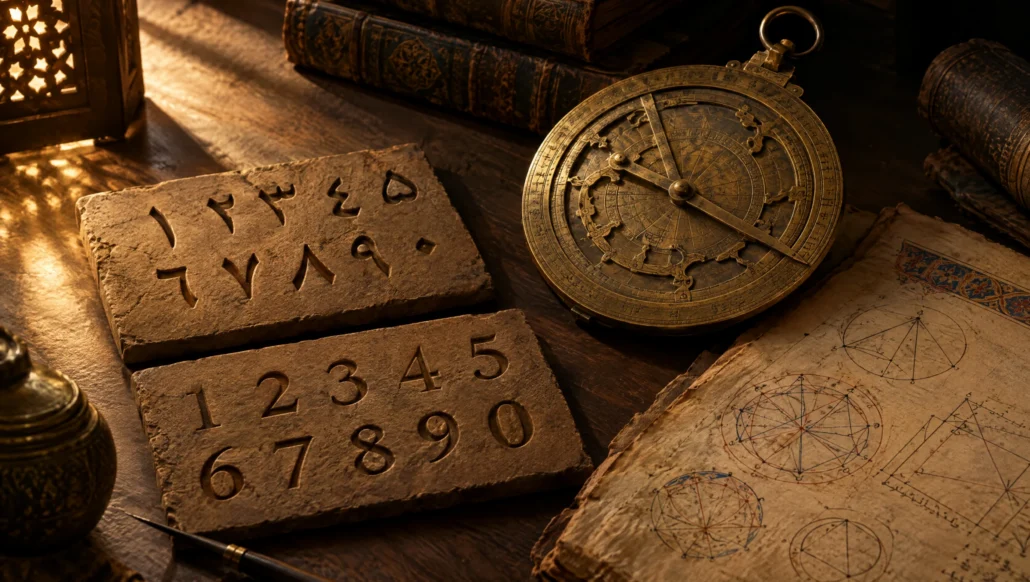
The digits 0 to 9 began in India, where mathematicians developed a decimal system in which a digit's position gives its value, together with a symbol for zero. Scholars in Baghdad adopted the system, and al-Khwarizmi wrote a widely copied book on Indian reckoning in the 9th century. Its Latin translation helped spread the method, and the word "algorithm" comes from his name.
In Europe, Gerbert of Aurillac promoted the digits in the late 10th century, and Fibonacci, who learned them in Béjaïa in present-day Algeria, made them widely known with his Liber Abaci in 1202. The shapes Europe adopted were the ones used in North Africa and al-Andalus, which became today's 0 to 9.
Why numbers run left to right in Arabic text
Arabic is written from right to left, but numbers are not. A multi-digit number is written with its largest place value on the left, exactly as in English, and Arabic speakers read it in that order, though a spoken number may name the units before the tens ("five and twenty").
Computers handle this automatically: the Unicode bidirectional algorithm keeps a run of digits in left-to-right order even inside a right-to-left paragraph, whether the digits are Western or Eastern.
Eastern and Western digits today
Two digit sets live side by side in the Arab world. The Maghreb uses Western digits. In Egypt, Sudan, the Levant, Iraq and the Gulf, Eastern Arabic digits are common on signs, in newspapers and on official papers, usually alongside Western ones, which dominate on phones, websites and in business.
Iran, Afghanistan and Pakistan use a Persian variant of the Eastern set, where 4, 5 and 6 have different shapes. If you are writing for a specific country, match what local newspapers and government sites use.
Frequently asked questions
What are Eastern Arabic numerals?
They are the digits ٠ ١ ٢ ٣ ٤ ٥ ٦ ٧ ٨ ٩, used with Arabic script in much of the Middle East. In Arabic they are often called Indian numerals (al-arqām al-hindiyya), a nod to their origin.
Why are 0 to 9 called Arabic numerals?
Europeans learned the decimal place-value system from Arabic sources, so they called the digits Arabic. The system itself began in India, which is why the full name used by historians is Hindu-Arabic numerals.
Are Arabic numbers written right to left?
No. Arabic text runs right to left, but multi-digit numbers are written and read from left to right, with the largest place value first. The year 2026 is ٢٠٢٦ in Eastern digits, in the same order.
Which Arab countries use Western digits?
Morocco, Algeria, Tunisia, Libya and Mauritania use Western digits almost exclusively. Elsewhere both sets are common, and Western digits are increasingly used online and in business.
What is the difference between Arabic and Persian digits?
Persian (and Urdu) digits are a variant of the Eastern Arabic set. Most shapes are the same, but 4, 5 and 6 are written differently, so the two sets use separate characters on computers.
Sources
- Eastern Arabic numerals (Wikipedia)
- Arabic numerals (Wikipedia)
- Hindu-Arabic numerals (Britannica)
- Muhammad ibn Musa al-Khwarizmi (Wikipedia)
Spotted an error? Tell us through the Pitch a Story page and we will correct it.